When shopping for water treatment in South Carolina, you'll encounter two common options: traditional water softeners and salt-free water conditioners. Despite similar marketing claims, these technologies work very differently - and the distinction matters for protecting your home.
How Water Softeners Work
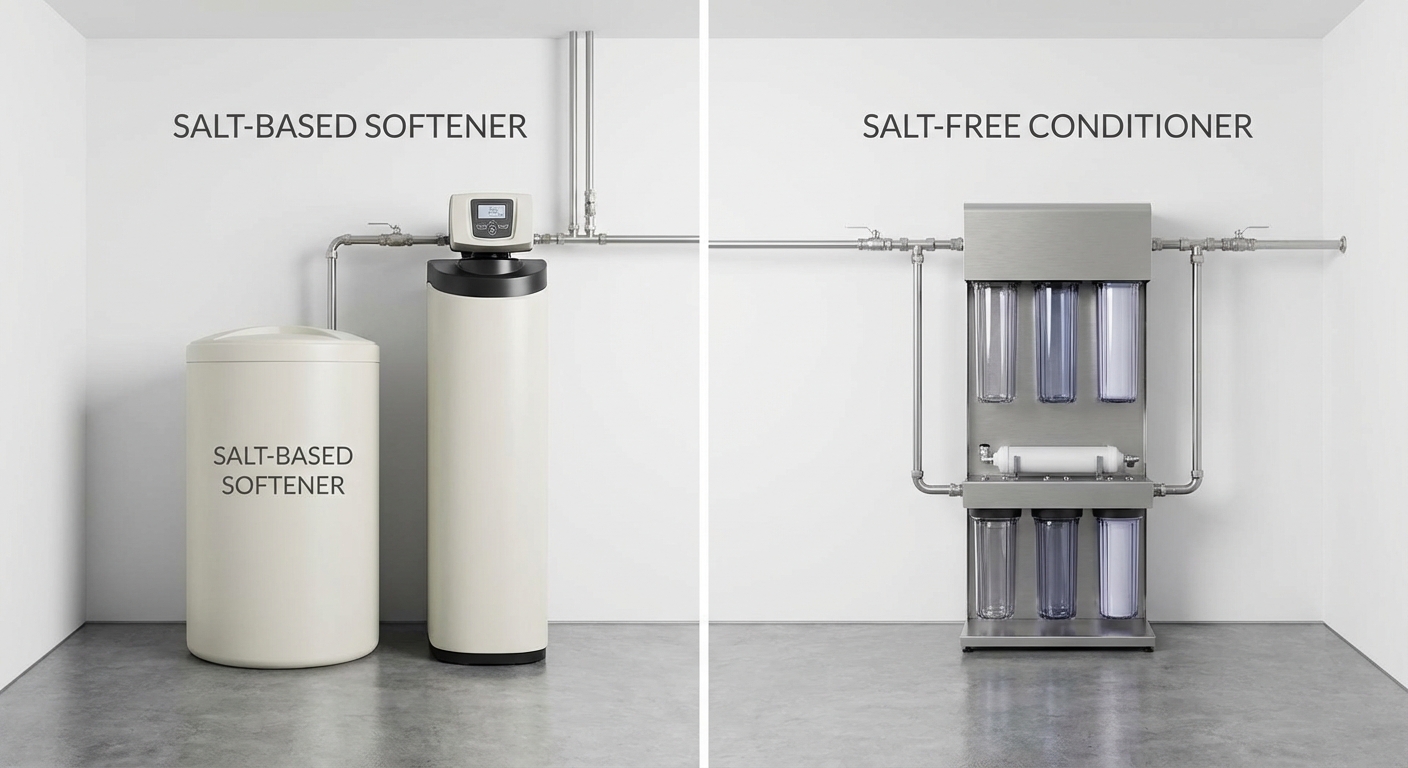
A water softener uses ion exchange to physically remove calcium and magnesium from your water. Hard water passes through a resin bed charged with sodium or potassium ions. The hardness minerals stick to the resin and are replaced with sodium ions. Periodically, the system regenerates by flushing the resin with a brine solution, washing the collected minerals down the drain.
Modern high-efficiency softeners like the Hydrotech 89 Series use upflow regeneration technology that reduces salt usage by 46% and water waste by 67% compared to traditional downflow systems. The result is genuinely soft water at 0 GPG hardness.
How Water Conditioners Work
Salt-free water conditioners (also called water descalers or anti-scale systems) don't actually remove hardness minerals. Instead, they use Template Assisted Crystallization (TAC) or electromagnetic waves to change the structure of calcium crystals so they're less likely to stick to surfaces. The minerals remain in your water - they're just supposed to flow through without forming scale.
The Key Difference
A water softener removes hardness minerals. A conditioner changes their form but leaves them in your water. If you test conditioned water, it will still measure as hard.
Head-to-Head Comparison
| Feature | Water Softener | Water Conditioner |
|---|---|---|
| Removes hardness minerals | Yes - 0 GPG | No - minerals remain |
| Scale prevention | Excellent - eliminates scale | Moderate - reduces but doesn't eliminate |
| Soap lathering improvement | Significant - 50% less soap needed | Minimal improvement |
| Skin and hair benefits | Noticeable - softer skin, less dry hair | Little to no difference |
| Salt/maintenance required | Yes - salt refills every 4-8 weeks | No salt needed |
| Water heater protection | Excellent - extends life 50%+ | Partial protection |
| Scientifically validated | Yes - NSF/ANSI 44 certified | Limited independent studies |
Which Is Better for South Carolina Homes?
For most South Carolina homeowners, a traditional water softener is the more effective choice. While Charleston metro water is relatively soft (3-5 GPG), areas like Summerville (5-8 GPG), Hilton Head (4-8 GPG), and Conway (4-7 GPG) have moderate to hard water that benefits significantly from true softening.
A conditioner might be adequate if you only want to reduce scale buildup and don't mind hard water's effects on soap, skin, and laundry. But if you want genuinely soft water with all the associated benefits - including extended appliance life, reduced soap usage, softer skin, and spot-free dishes - a water softener is the clear winner.
The Best of Both Worlds
For comprehensive treatment, consider a whole-house water refining system like the Hydrotech HTO Up Flow Series. It combines a water softener with catalytic carbon filtration in one dual-tank unit, addressing both hardness and chlorine/taste issues. This eliminates the need for multiple separate systems while treating every drop of water in your home.